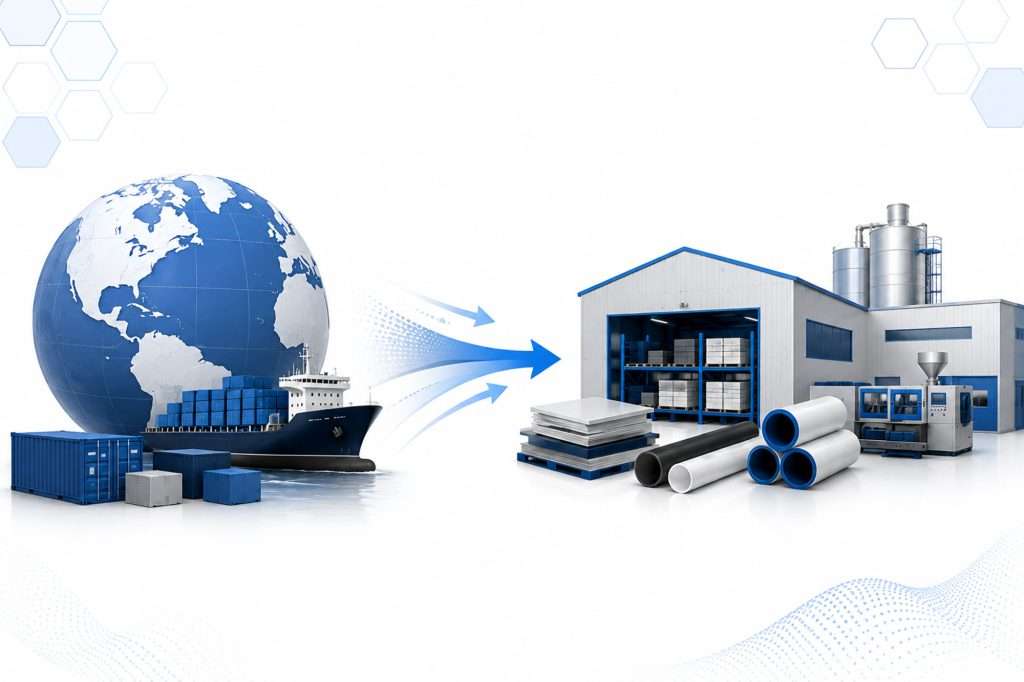
For years, many manufacturers built their plastics sourcing strategy around one priority: lowest unit cost.
That strategy is changing.
In 2026, plastic buyers are placing more value on supply reliability, shorter lead times, regional inventory, material traceability, and supplier responsiveness. The question is no longer just, “Who has the lowest price per pound?” It is also, “Who can help us keep production moving when freight, tariffs, resin availability, or global events change?”
This shift is commonly referred to as supply chain regionalization. For plastic materials, it means manufacturers are looking closer to home for resin, sheet, rod, tube, machined components, and cut-to-size plastic materials instead of relying too heavily on long global supply routes.

What Is Plastics Supply Chain Regionalization?
Plastics supply chain regionalization is the practice of sourcing, producing, converting, stocking, and distributing plastic materials within a closer geographic region. Instead of depending on a long chain of international suppliers, ports, ocean freight, importers, and multiple handoffs, manufacturers build a sourcing network that is closer to their production facilities and end customers.
This does not always mean every material must be domestically produced. In many cases, regionalization means creating a more resilient North American sourcing strategy that includes U.S.-based distributors, domestic inventory, approved alternate materials, and supplier relationships that can respond quickly when market conditions change.
M. Holland identified plastics supply chain regionalization as a major 2026 trend, noting that manufacturers are rethinking where materials come from because the lowest-cost supplier is no longer automatically the most competitive option when disruption risk is factored in.
Why Manufacturers Are Rethinking Plastic Sourcing
Several forces are pushing manufacturers to evaluate regional plastic sourcing more seriously in 2026.
1. Raw material costs are a top manufacturing concern
The National Association of Manufacturers’ Q2 2026 Manufacturers’ Outlook Survey found that 83.1% of manufacturers cited rising raw material costs as a top business challenge, up sharply from the prior quarter. The same survey reported that 71.8% cited trade uncertainties as a top challenge and that raw material and other input costs were expected to rise 5.8%.
For plastic buyers, this makes material planning more difficult. Resin, sheet, rod, tube, and finished plastic components may be affected by feedstock costs, freight costs, tariffs, energy inputs, demand swings, and availability constraints. A supplier with regional inventory and responsive support can help buyers adjust faster when pricing or availability changes.
2. Global petrochemical disruption can quickly affect plastic pricing
Plastic materials are tied to global petrochemical markets. In March 2026, Reuters reported that disruption to oil and petrochemical flows through the Strait of Hormuz tightened global chemical supply and lifted prices for plastics and polymers. The report noted that the Middle East accounted for more than 40% of global polyethylene exports in 2025 and that polyethylene and polypropylene prices had surged after the conflict began.
That matters because polyethylene, polypropylene, and other commodity plastics are used across industrial, packaging, automotive, consumer, and manufacturing applications. Even companies that do not buy directly from the Middle East can feel the effects when global supply chains tighten, freight becomes less predictable, or replacement materials become harder to source.
3. Supplier delivery performance and material shortages remain concerns
Reuters also reported that U.S. manufacturing activity rose in May 2026, but supplier delivery performance slowed for the sixth consecutive month. The same report noted shortages in products including resins, semiconductors, aluminum, steel products, and electronic components.
For manufacturers, delays in plastic materials can create a ripple effect. A delayed sheet, rod, machined component, wear strip, liner, guard, insulator, or replacement part can hold up maintenance, prototyping, production, repair work, or customer delivery commitments.
Regional suppliers can help reduce that risk by shortening the distance between the buyer and available material.
4. U.S. resin production remains an important supply advantage
The American Chemistry Council reported that U.S. production of major plastic resins totaled 9.3 billion pounds in May 2026, a 4.0% increase from the prior month and a 12.7% increase from May 2025. Year-to-date production reached 44.5 billion pounds, up 7.7% from the same period in 2025.
This does not eliminate all supply chain risk, but it reinforces why many buyers are paying closer attention to domestic and regional material availability. When global pricing, shipping, or tariff conditions shift, access to U.S. resin production, regional distributors, and local stocking programs can become a competitive advantage.
Lowest Price Is Not Always Lowest Cost
A lower material price can look attractive on a purchase order. But the true cost of a plastic material includes more than the price per pound.
Manufacturers also need to consider:
- Freight and fuel costs
- Tariffs or import exposure
- Lead time variability
- Minimum order requirements
- Material certification needs
- Risk of substitutions or stockouts
- Downtime caused by unavailable material
- Waste from buying oversized sheets, rods, or blocks
- Engineering time spent requalifying alternatives
A lower-cost material that arrives late, requires extra machining, creates more scrap, or forces a production delay may become more expensive than a slightly higher-priced regional option.
This is especially true for industrial plastic applications where material performance matters. Choosing the wrong material or waiting too long for the right one can affect wear life, chemical resistance, temperature performance, electrical properties, dimensional stability, or safety compliance.
Where Regional Plastic Sourcing Matters Most
Regional sourcing is especially valuable when manufacturers need speed, flexibility, and material guidance.
Common examples include:
Maintenance and repair parts
Plants often need plastic materials quickly for replacement wear strips, guides, liners, guards, spacers, bushings, rollers, or machine components. Regional suppliers can help reduce downtime when a critical part or material is needed quickly.
Cut-to-size plastic materials
Buying full sheets or oversized stock can create unnecessary waste and additional labor. A regional supplier that offers cut-to-size plastic materials can help buyers reduce scrap, control costs, and simplify ordering.
suggested read: How Cut-to-Size Plastics Reduce Waste in Industrial Applications
Material substitutions
When a preferred resin or plastic grade is expensive, delayed, or unavailable, manufacturers may need help identifying alternatives. For example, a buyer may need to compare HDPE, UHMW, acetal, nylon, polypropylene, PVC, PEEK, or G-10/FR-4 based on application requirements.
suggested read: PPH vs HDPE vs PP Copolymer: How to Choose the Right Plastic for Your Application
Prototype and short-run production
Engineering teams often need material quickly for testing, prototyping, fixture building, or small-batch production. Regional suppliers can help shorten the timeline between design, quote, material selection, and fabrication.
High-performance or specialty applications
Some applications require plastics with specific properties such as chemical resistance, high temperature performance, electrical insulation, wear resistance, FDA compliance, static control, or low moisture absorption. In these cases, supplier knowledge is just as important as inventory.
suggested read: When Do You Actually Need PEEK Plastic?
Regionalization Does Not Mean Ignoring Global Supply
Regionalization is not the same as abandoning global sourcing. Many plastic materials, additives, compounds, and finished components still move through global supply networks.
The goal is not to eliminate every global supplier. The goal is to reduce overdependence on any single source, region, shipping lane, resin grade, or long-lead supply route.
A practical regional sourcing strategy may include:
1. Identifying which plastic materials are most critical to production
2. Reviewing where those materials are produced, stocked, and converted
3. Creating approved alternate materials where possible
4. Working with suppliers that can provide documentation and technical guidance
5. Keeping regional stocking options available for urgent or repeat-use materials
6. Factoring lead time, freight, tariffs, and downtime into total material cost
Deloitte’s 2026 Manufacturing Industry Outlook notes that supply chain complexity is likely to continue increasing, making targeted investments in tools and strategy important for manufacturers that want to stay competitive.
How Plastic Buyers Can Build a Stronger Regional Sourcing Strategy
Manufacturers can start by reviewing the materials they buy most often and identifying where sourcing risk exists.
Important questions include:
- Which plastic materials are used in repeat production or maintenance?
- Which materials have long lead times or limited approved suppliers?
- Are there domestic or regional sources for sheet, rod, tube, or cut-to-size stock?
- Are alternate materials already approved by engineering?
- Are certifications, data sheets, or compliance documents required?
- Is the current supplier able to advise on substitutions when pricing or availability changes?
- Does the purchasing team understand the true cost of delays, freight, waste, and downtime?
Plastic buyers should also evaluate supplier responsiveness. When material availability changes, speed matters. A supplier that can help identify options, quote quickly, cut material to size, provide documentation, and support application questions can reduce friction across purchasing, engineering, and operations.
Sterling Plastics Helps Manufacturers Source Smarter
Sterling Plastics supports manufacturers with engineered plastic materials, cut-to-size service, material guidance, technical documentation, and responsive quote support.
As plastic supply chains become more regional, more volatile, and more dependent on supplier knowledge, manufacturers need more than a material source. They need a plastics partner that can help them evaluate options, reduce waste, control cost, and keep production moving.
Whether you are comparing HDPE, UHMW, acetal, nylon, polypropylene, PVC, PEEK, G-10/FR-4, or another engineered plastic, Sterling Plastics can help you identify the right material for your application and sourcing requirements.
Need Help Finding a Reliable Plastic Material?
If your team is facing longer lead times, rising material costs, supply uncertainty, or material substitution questions, Sterling Plastics can help.
Contact Sterling Plastics to request a quote, review material options, or discuss cut-to-size plastic materials for your next application.
References
M. Holland, “2026 Trend Breakdown: Plastics Supply Chain Regionalization.”
National Association of Manufacturers, “2026 Second Quarter Manufacturers’ Outlook Survey.”
Reuters, “Iran war chokes petrochemical supply, sends plastic prices soaring.”
Reuters, “U.S. manufacturing activity at four-year high, supply constraints growing.”
American Chemistry Council, “ACC Releases May 2026 Resin Production and Sales Statistics.”
Deloitte, “2026 Manufacturing Industry Outlook.”