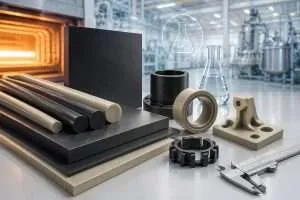
PEEK (Polyether Ether Ketone) is often described as a “premium” engineering plastic — and for good reason. It offers exceptional strength, temperature resistance, and chemical stability.
But in real-world applications, PEEK is frequently over-specified.
At Sterling Plastics, we see this all the time: engineers and procurement teams default to PEEK because it feels like the safest choice — only to discover later that it increased cost, lead time, and complexity without delivering meaningful performance benefits.
This article explains when PEEK plastic is truly required, when it’s unnecessary, and how to avoid overspending without increasing risk.
Why PEEK Plastic Has a Reputation for “Playing It Safe”
PEEK earns its reputation because it performs where many plastics fail.
Typical reasons PEEK is specified:
- Continuous operating temperatures above 480°F (250°C)
- Aggressive chemical exposure
- High mechanical stress under load
- Applications requiring dimensional stability at elevated temperatures
- Aerospace, medical, semiconductor, or high-end industrial use cases
Sterling offers multiple PEEK material options to support these demanding environments, including unfilled and specialty-grade variants.
Common Situations Where PEEK Is Overkill
In practice, PEEK is often specified “just in case,” rather than because the application demands it.
Here are the most common over-specification scenarios we see.
1. Temperature Requirements Are Overestimate
PEEK excels at high temperatures — but many applications never approach its limits.
If your operating temperature stays:
- Below ~250°F
- Or only spikes briefly during operation
Then using PEEK may be unnecessary. In many cases, engineers can evaluate alternative materials before escalating to PEEK, especially when temperature exposure is intermittent rather than sustained.
2. Chemical Resistance Is Assumed, Not Tested
PEEK offers broad chemical resistance, but many applications encounter only:
- Oils
- Solvents
- Mild acids
- Common industrial cleaning agents
If the chemical exposure is known and controlled, PEEK’s full resistance profile may not be required, and less costly engineered plastics can often perform reliably.
3. Mechanical Loads Don’t Justify the Cost
PEEK’s mechanical strength is impressive — but strength alone rarely justifies its use.
If:
- Loads are moderate
- Stress is intermittent
- Geometry or wall thickness can be adjusted
Then alternatives may meet performance requirements without PEEK’s material and machining cost.
The Hidden Cost of Over-Specifying PEEK
PEEK doesn’t just cost more per pound.
It can also affect:
- Lead times (limited suppliers, longer machining cycles)
- Machining cost (tool wear, slower feeds)
- Supply chain flexibility
- Revision speed when designs change
For procurement teams, this often shows up as:
- Delayed builds
- Budget overruns
- Fewer substitution options during shortages
These are factors that don’t appear on a datasheet — but matter greatly in production.
When PEEK Plastic Is the Right Call
Despite the risks of overuse, there are applications where PEEK is absolutely the correct choice.
PEEK is typically justified when multiple of the following apply:
- Sustained operating temperatures above 480°F
- Continuous mechanical stress under load
- Combined exposure to heat and aggressive chemicals
- Tight tolerances that must hold at temperature
- Regulatory or industry requirements that mandate PEEK
In these cases, selecting a proven grade — such as Unfilled PEEK — can be critical to long-term performance and compliance.
A Smarter Material Selection Approach
Rather than starting with PEEK by default, a more efficient approach is to:
- Define actual operating conditions
- Separate continuous vs peak temperature exposure
- Identify acceptable tolerance ranges
- Evaluate lower-cost plastics first
- Escalate to PEEK only when necessary
This process reduces risk while protecting budget and lead time.
Why This Matters for Engineers and Procurement Teams
Material over-specification is rarely intentional. It’s usually driven by:
- Incomplete data
- Risk aversion
- Time pressure
But over time, those decisions compound:
- Higher unit costs
- Longer lead times
- Fewer sourcing options
Understanding when PEEK is required — and when it isn’t — gives teams more control and flexibility.
Final Takeaway
PEEK plastic is an exceptional material — when the application truly demands it.
But if your operating conditions don’t push its limits, PEEK may be adding cost and complexity without delivering proportional value.
The smartest material decisions balance:
- Performance
- Availability
- Machinability
- Cost
- Risk
And sometimes, the best choice isn’t the most extreme one.
How Sterling Plastics Can Help
Sterling Plastics works with engineers and sourcing teams to evaluate real-world requirements, not assumptions — helping identify the right material for each application.
If you’re questioning whether PEEK is necessary for your project, reviewing Sterling’s available PEEK material offerings is a good starting point before committing to a specification.